Understanding Dyscalculia
An evidence‑based resource on dyscalculia — a specific learning disability affecting the understanding of numbers and arithmetic — for parents, teachers, and dyscalculic learners themselves.
Last updated: 24 October 2026
What Is Dyscalculia?
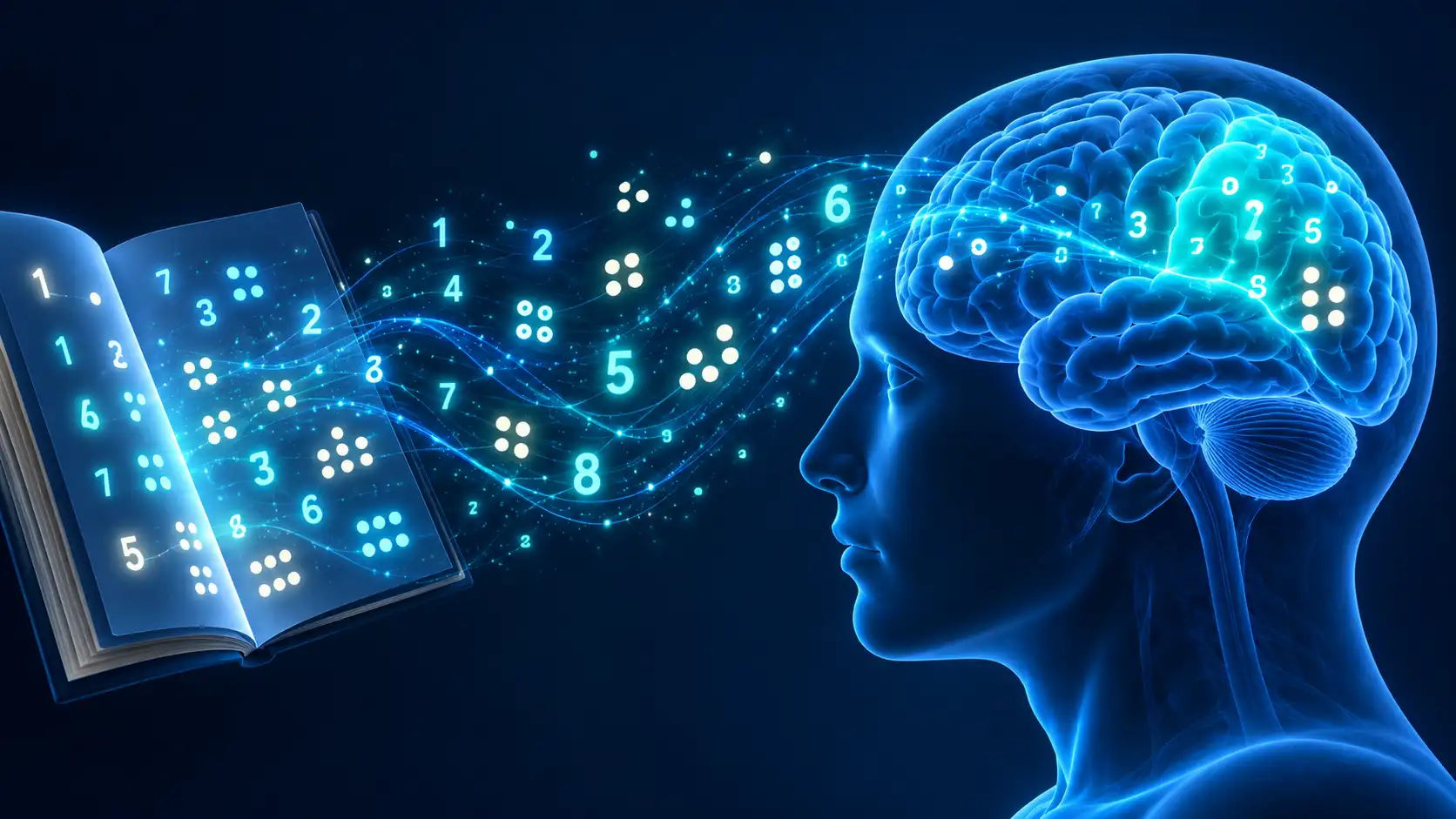
Dyscalculia is a specific learning disability that affects the ability to understand and work with numbers and arithmetic. A commonly studied and influential feature is difficulty representing, comparing, and manipulating numerical quantities — the "number sense" that lets us judge how many things are in a set, place numbers on a mental number line, and link spoken words and written symbols to the amounts they represent.[1] Dyscalculia is heterogeneous, however, and no single cognitive deficit explains every case — working memory, retrieval of number facts, and learning of procedures also contribute.[3][2] These difficulties are persistent and are unexpected given a person's other abilities and the teaching they have received.[3]
sense
In clinical diagnostic systems, this is generally represented as Specific Learning Disorder, with impairment in mathematics (DSM-5-TR); "dyscalculia" is widely used as a descriptive term for persistent, significant maths difficulties rather than being a separate DSM diagnosis, and it has no single universally agreed definition across countries and professions.[8][2] Reported prevalence (commonly ~3–7%) varies substantially with the definition, age, thresholds, and assessment methods used.[2][3]
Maths difficulty is not the same as dyscalculia. A person can struggle with maths for many reasons — inadequate or interrupted instruction, language barriers, anxiety, ADHD, limited opportunity, sensory or intellectual difficulties, or simply being behind — without having developmental dyscalculia. Dyscalculia refers to marked, persistent difficulty that is unexpected given a person's broader development and that persists despite appropriate teaching.[3][2]
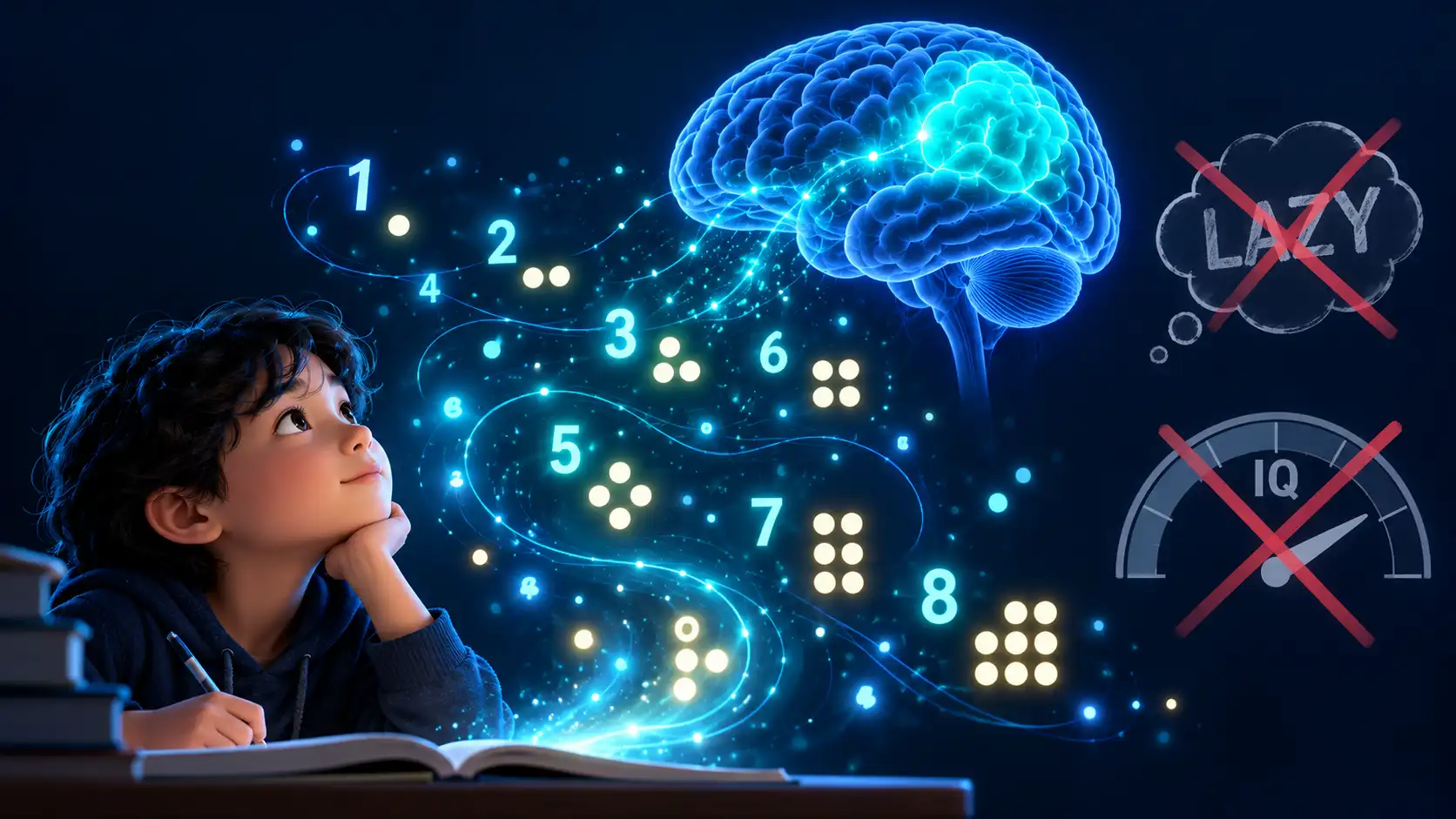
What dyscalculia is not. It is not a sign of low intelligence — it occurs across the full range of ability, including in people who are strong in other subjects.[3] It is not simply "being bad at maths," not the result of laziness or poor effort, and not merely a consequence of inadequate teaching — though weak instruction can also cause maths difficulty, dyscalculia persists even with good teaching and needs targeted, structured support.[1][2]
Research increasingly points to a core deficit in understanding sets and their numerosities — the foundation on which all of elementary-school mathematics is built — rather than a general problem with intelligence or motivation.
Number Sense & How It Works
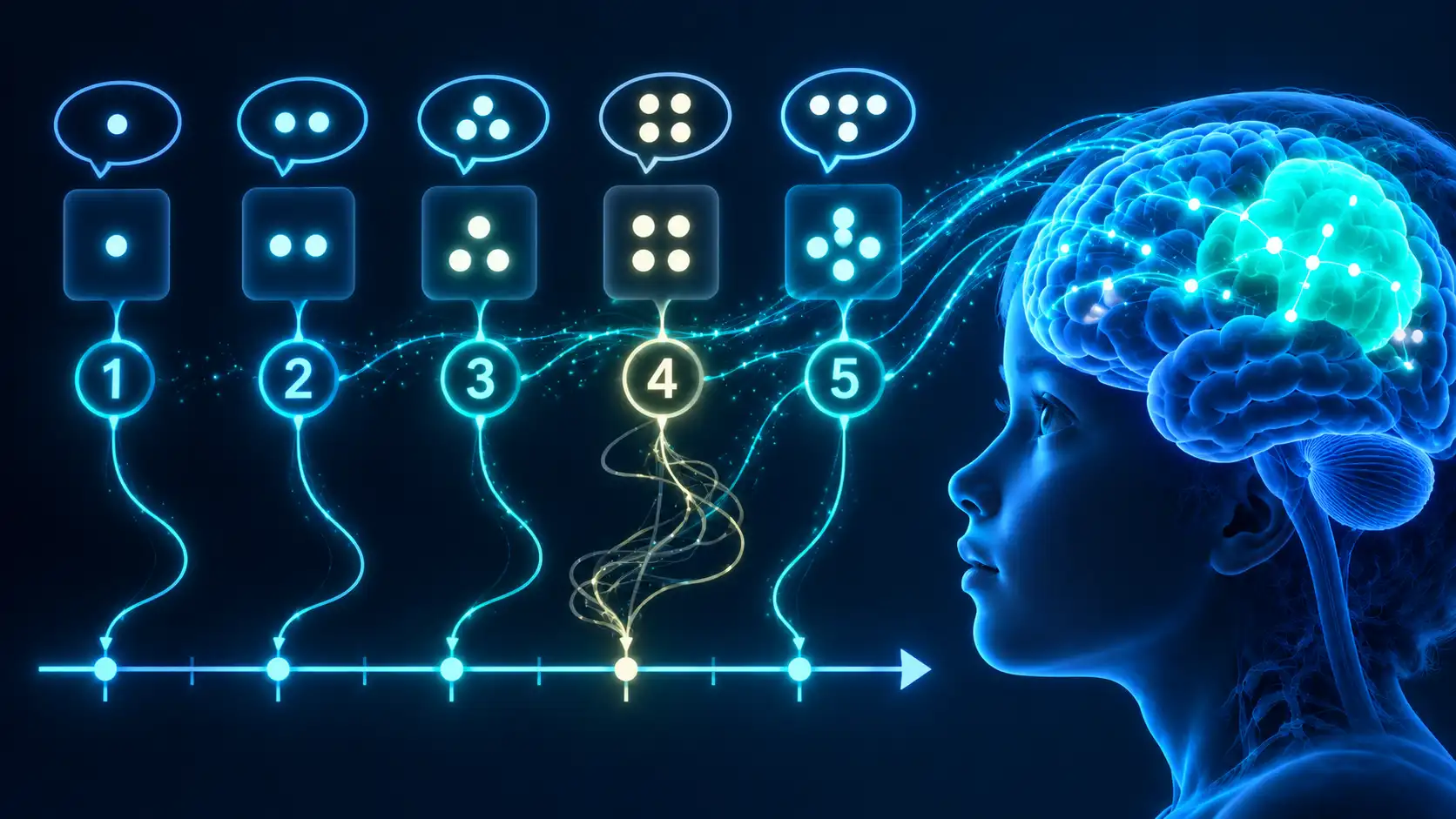
Long before formal schooling, children develop a sense of quantity — they can tell that five apples are more than two, and can instantly recognise small amounts without counting (a skill called subitizing). Learning arithmetic builds on this foundation: connecting the amount in a set to its spoken word ("five") and its written symbol ("5"), and placing numbers in order along a mental number line. In dyscalculia, this foundational number sense often works less efficiently, so building fluent, accurate number skills is effortful and slow.[1][2]
Importantly, dyscalculia is heterogeneous — it does not look the same in everyone. A difficulty with core quantity processing is central for many, but working memory, retrieval of facts from long-term memory, and learning of procedures also contribute, and no single deficit explains every case.[3][2]
🔢 Quantity & magnitude
A difficulty representing and comparing numerical magnitude — how big or small a quantity is — is a widely reported core feature. Children may struggle to say which of two numbers is larger, or to estimate amounts, which makes the rest of arithmetic harder to build.[1]
🧠 Retrieving number facts
Many dyscalculic learners find it hard to retrieve basic arithmetic facts (like 7 + 5 or times tables) automatically from memory, and instead fall back on slow counting strategies well beyond the age when peers have moved on.[3]
⏳ Working memory
Holding numbers in mind while calculating draws heavily on working memory. Weaknesses here, found in many children with a maths learning disability, make multi-step problems and "carrying" particularly effortful.[3]
🪜 Counting & procedures
Delays in learning counting principles and arithmetic procedures (such as place value, borrowing, and multi-digit methods) are common, and often persist longer than in typically developing peers.[3]
What Brain Science and Genetics Show
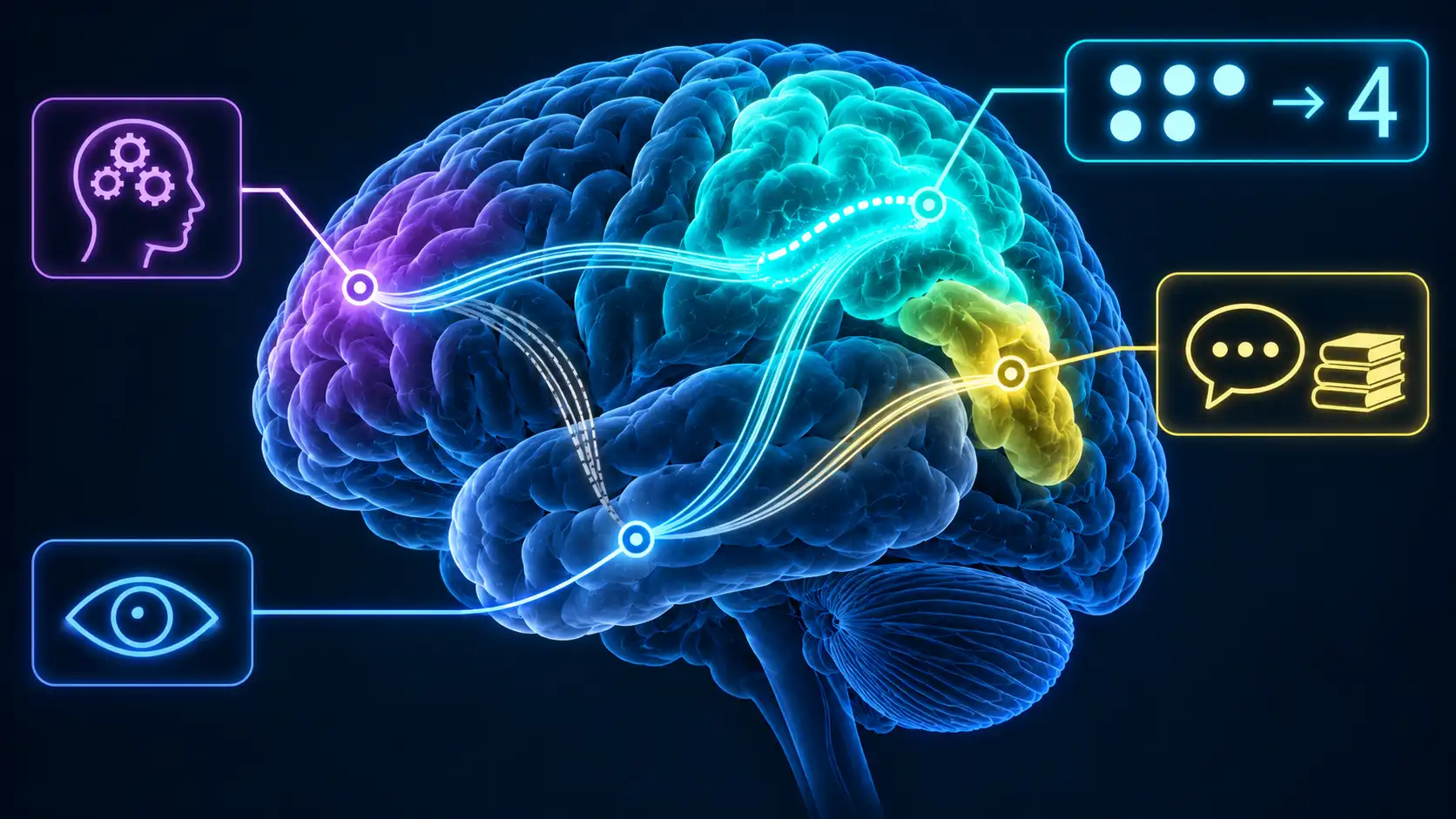
Processing numbers draws on a network of brain regions, with the parietal lobe — and especially the intraparietal sulcus (IPS) — playing a central role in representing numerical magnitude. Other regions, including the angular gyrus, contribute to the verbal side of arithmetic (such as retrieving memorised facts), within integrated models of how the brain handles number.[1]
Structural and functional neuroimaging studies have identified, at the group level, differences in these number-related regions in people with dyscalculia, as well as differences in the white-matter connections that link parietal, temporal, and frontal areas — leading some researchers to describe dyscalculia partly as a "dysconnection" of number networks and to emphasise broader, domain-general mechanisms too.[4][2] As with other learning differences, these are research-level group patterns: there is no diagnostic brain scan for dyscalculia.[2]
🧬 Genetics
Maths ability runs in families. Twin studies indicate substantial genetic influence on individual differences in mathematical ability and numeracy — in the early school years, as heritable as literacy and more so than general intelligence.[6] This describes the heritability of variation in maths ability, not a single inherited "maths gene" for dyscalculia: mathematical ability is shaped by many genetic variants alongside environmental influences, and an individual's difficulties cannot be predicted from genetic information.[7]
How Dyscalculia Shows Up
Dyscalculia looks different at different ages, and no single sign is diagnostic. The pattern below reflects features commonly described in the research and clinical literature; a formal assessment is needed to interpret them.[2][3]

| Stage | Common signs |
|---|---|
| Preschool | Difficulty learning to count and recall number names; trouble recognising number symbols; difficulty comparing small quantities or seeing which group has "more" (these raise risk — they are not diagnostic) |
| Early school | Slow, effortful counting; reliance on fingers well beyond peers; difficulty learning number facts and times tables; trouble with place value and multi-digit methods, despite good teaching |
| Later school | Persistently slow, error-prone arithmetic; difficulty estimating; trouble with word problems, fractions, and sequences; often accompanied by maths anxiety and avoidance |
| Adults | Ongoing difficulty with budgeting, time management, estimation, measurement, and everyday number tasks — often alongside well-developed abilities in other areas |
🌱 Difficulty that persists despite good teaching
A recurring feature is number and arithmetic difficulty that persists even with instruction that works for a child's peers, and that is often greater than the person's broader development and opportunity would predict. As with other specific learning disorders, a formal IQ–achievement discrepancy is not required to identify dyscalculia.[3][8]
How Dyscalculia Is Identified
There is no single blood test or brain scan for dyscalculia; identification is a clinical and educational judgement based on a full profile. In DSM-5-TR, it is diagnosed as Specific Learning Disorder, with impairment in mathematics. Diagnosis requires learning difficulties that have persisted for at least 6 months despite targeted intervention, mathematics skills substantially below what is expected for the person's age, onset during the school years (though difficulties may become clearly apparent only when mathematical demands increase), and clinically significant interference with school, work, or daily life — with alternative explanations (such as intellectual disability, sensory problems, or inadequate instruction) considered.[8] Defining homogeneous criteria is genuinely challenging because dyscalculia is so varied.[2]

📋 What an assessment looks at
Assessment is carried out by appropriately qualified professionals — which, depending on the country and system, may include educational or clinical psychologists, specialist teachers, or other professionals — who evaluate number sense and magnitude comparison, counting, arithmetic fluency and fact retrieval, place value, and maths reasoning, set against measures of the person's broader reasoning and language to build a full profile.[2][3]
✅ Considering other factors
A good assessment also considers hearing and vision, educational opportunity, language background, attention, and maths anxiety, as well as other developmental or neurological factors that can affect maths — to understand the full picture and ensure support fits the individual.[8][2]
What Often Travels With Dyscalculia
Dyscalculia frequently co-occurs with other neurodevelopmental conditions, and overlap is common rather than exceptional.[3]
Dyslexia
Difficulty with reading (dyslexia) and difficulty with maths often appear together — they share some cognitive and genetic risk factors, and reading difficulty can also make word problems harder.[3][6]
ADHD
Attention-deficit/hyperactivity disorder co-occurs with maths difficulty more often than chance. Some cognitive demands, including attention and working memory, may contribute to difficulties in both, and shared genetic and environmental influences may also underlie the overlap.[3]
Language difficulties
Developmental language difficulties can overlap with dyscalculia and affect the verbal and word-problem side of mathematics.[2]
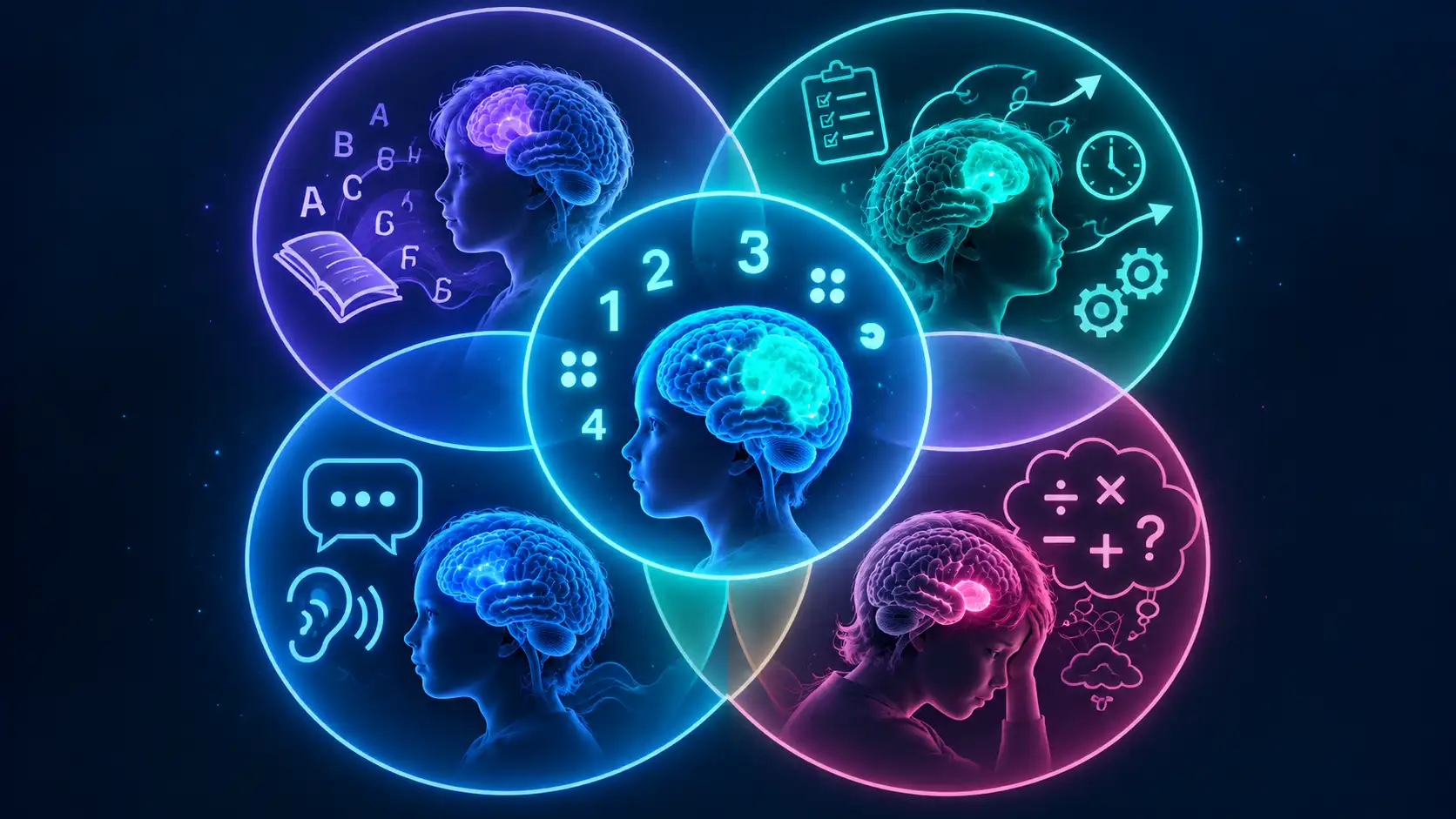
Maths anxiety & emotional wellbeing
Repeated mathematical difficulty — and being misjudged as careless or "not trying" — can contribute to maths anxiety, avoidance, low self-esteem, and reduced confidence; and maths anxiety can in turn interfere with mathematical performance, creating a feedback loop. Timely identification, the right support, and an explanation that makes sense of the difficulty are protective. If low mood becomes overwhelming, please reach out — see Support & Resources below.[2][3]
What Genuinely Helps
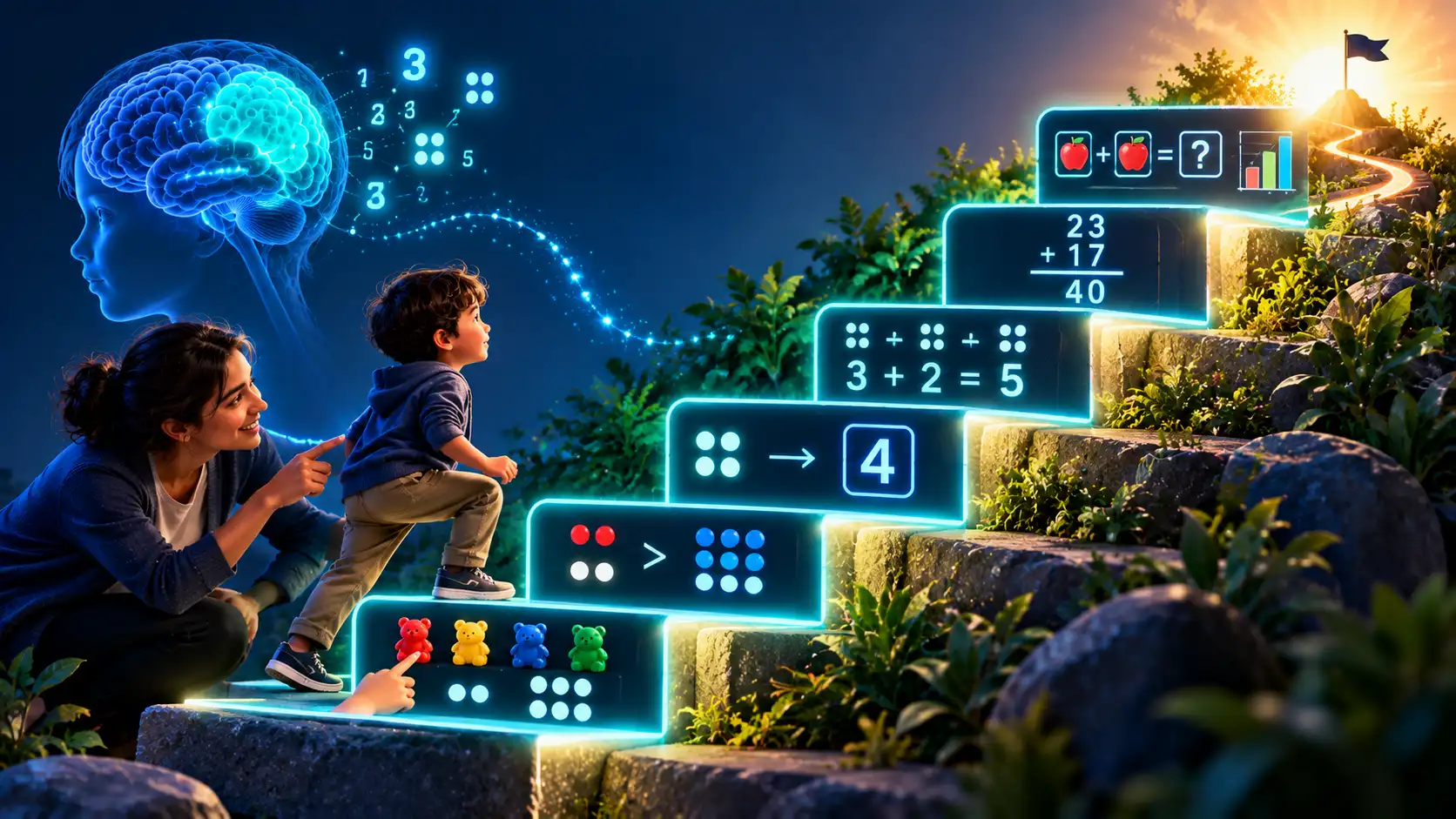
The encouraging news is that number skills can be strengthened with the right teaching — and interventions that target a learner's specific mathematical difficulties show promise, including for children who are already struggling.[5][1]
🔢 Build number skills directly
Because an understanding of quantity underpins arithmetic, interventions that strengthen number sense and magnitude processing can be valuable. Some structured and computer-based interventions targeting numerical magnitude have shown benefits in research studies, though effects vary by intervention and learner — for example, a theory-driven number-sense training programme improved symbolic quantity-discrimination ability in children, including those with learning difficulties.[5][1]
📚 Explicit, structured teaching
Dyscalculic learners benefit from explicit, systematic, structured maths instruction: direct teaching with lots of practice, using concrete materials and visual models (such as number lines and manipulatives) alongside symbols, introduced in a carefully sequenced way suited to the learner. Support tends to work best when it is early, individualised, and sustained.[2][3]
🛠️ Accommodations & technology
Alongside direct teaching, accommodations remove barriers while skills develop: calculators where permitted and appropriate to the task or assessment, extra time, number lines and multiplication grids, fewer problems per page, reduced copying, and support with word problems. These do not "lower the bar" — they let dyscalculic learners show what they know. With the right support, dyscalculic people can and do thrive in education, work, and everyday life.[2]
🤝 Support & Resources
Trusted, non-commercial organisations with guidance for families, educators, and adults — plus mental-health support if the strain ever feels too much.[9][10]
If you or someone you love is struggling emotionally or in crisis, please reach out: 🇺🇸 988 (Suicide & Crisis Lifeline) · 🇬🇧 Samaritans 116 123 · or your local emergency number (911 / 999 / 112). You are not alone.
Cited Sources
Key factual claims in this article are referenced to peer-reviewed publications or authoritative organisations. Bibliographic details were verified against the primary sources via PubMed; DOI or publisher links are provided where available.
- Butterworth, B., Varma, S., & Laurillard, D. (2011). Dyscalculia: from brain to education. Science, 332(6033), 1049–1053. DOI: 10.1126/science.1201536 · PubMed: PMID 21617068
- Kucian, K., & von Aster, M. (2015). Developmental dyscalculia. European Journal of Pediatrics, 174(1), 1–13. DOI: 10.1007/s00431-014-2455-7 · PubMed: PMID 25529864
- Geary, D. C. (2011). Consequences, characteristics, and causes of mathematical learning disabilities and persistent low achievement in mathematics. Journal of Developmental and Behavioral Pediatrics, 32(3), 250–263. DOI: 10.1097/DBP.0b013e318209edef · Free PMC: PMC3131082 · PubMed: PMID 21285895
- Kucian, K., Ashkenazi, S. S., Hänggi, J., et al. (2014). Developmental dyscalculia: a dysconnection syndrome? Brain Structure & Function, 219(5), 1721–1733. DOI: 10.1007/s00429-013-0597-4 · PubMed: PMID 23783231
- Chang, H., Chen, L., Zhang, Y., et al. (2022). Foundational number sense training gains are predicted by hippocampal-parietal circuits. Journal of Neuroscience, 42(19), 4000–4015. DOI: 10.1523/JNEUROSCI.1005-21.2022 · Free PMC: PMC9097592 · PubMed: PMID 35410879
- Kovas, Y., Voronin, I., Kaydalov, A., Malykh, S. B., Dale, P. S., & Plomin, R. (2013). Literacy and numeracy are more heritable than intelligence in primary school. Psychological Science, 24(10), 2048–2056. DOI: 10.1177/0956797613486982 · Free PMC: PMC3834736 · PubMed: PMID 24002885
- Docherty, S. J., Kovas, Y., & Plomin, R. (2011). Gene-environment interaction in the etiology of mathematical ability using SNP sets. Behavior Genetics, 41(1), 141–154. DOI: 10.1007/s10519-010-9405-6 · Free PMC: PMC3029801 · PubMed: PMID 20978832
- American Psychiatric Association. (2022). Diagnostic and Statistical Manual of Mental Disorders, Fifth Edition, Text Revision (DSM-5-TR) — Specific Learning Disorder (with impairment in mathematics). Washington, DC: APA. DOI: 10.1176/appi.books.9780890425787
- Understood.org. Dyscalculia — resources on maths learning difficulties for families and educators. Available: understood.org
- British Dyslexia Association (BDA). Dyscalculia and maths difficulties — guidance and resources. Available: bdadyslexia.org.uk
🤖 AI Assistance Disclosure: This article was researched and structured with the assistance of Artificial Intelligence (AI) under human editorial oversight. Key factual claims are referenced to peer-reviewed sources, and bibliographic details were verified against the primary literature via PubMed. AI-generated content may contain errors or omissions — always verify information with a qualified professional. Not a substitute for professional advice.
🚫 Non-Professional Authorship: The author(s) and editors at Ocxly Neuro Labs are not licensed medical, psychological, or educational-assessment professionals. This page is an educational synthesis of publicly available literature.