Understanding Dysgraphia
An evidence‑based resource on dysgraphia — persistent difficulty with writing, from forming letters to putting ideas on the page — for parents, teachers, and writers themselves.
Last updated: 24 October 2026

What Is Dysgraphia?
"Dysgraphia" is a term used to describe persistent, significant difficulty with writing — difficulty that is out of step with a person's age and cognitive level despite adequate instruction.[1] In practice the word is used in more than one way: sometimes for difficulty with the physical act of writing (handwriting and letter formation), sometimes more broadly for difficulty with written expression (spelling, grammar, and organising ideas on the page). It is not itself a single, universally agreed diagnosis, and it remains comparatively under-studied.[1][2]

sides
missed
persist
In clinical diagnostic systems, writing difficulty is generally represented as Specific Learning Disorder, with impairment in written expression (DSM-5-TR); "dysgraphia" is a descriptive term rather than a separate DSM diagnosis, and definitions differ across countries and systems (for example between DSM and ICD).[7][2]
What dysgraphia is not. Messy or slow writing is not a sign of low intelligence — writing difficulty occurs across the full range of ability.[1] It is not simply laziness or carelessness, and it is not merely the result of poor teaching, although inadequate instruction can also cause writing difficulty. And writing difficulty has many possible causes — attention, motor coordination, language, limited practice, or another condition — so not every struggling writer has dysgraphia.[1][2]
Writing is a complex task that is vital to learning. Dysgraphia is poorly understood and is often undiagnosed, and it has a high rate of co-morbidity with other learning and psychiatric conditions — which is why careful, whole-picture assessment matters.
Transcription & Composition
Writing is far more than moving a pen. It draws on two broad sets of skills at once. Transcription is getting language onto the page — forming letters by hand (or typing) and spelling. Composition is generating and organising ideas into sentences and texts. When transcription is effortful, it can place greater demands on working memory and leave fewer cognitive resources available for generating and organising ideas — so the writing as a whole can suffer.[1][4]
Dysgraphia is heterogeneous: different people struggle in different places along this chain, and researchers have proposed several mechanisms rather than one agreed cause.[1][2]

✍️ Handwriting & letter formation
Producing legible letters smoothly and automatically is a demanding motor task. When it stays slow and effortful, writing is laborious and legibility suffers — a hallmark of the handwriting side of dysgraphia.[3]
🔤 Spelling
Spelling draws on overlapping phonological, orthographic, morphological, and language processes that are also involved in reading, so spelling difficulties frequently co-occur with dyslexia and other language-based learning difficulties.[2]
Component Skills & Contributing Factors
Handwriting is a complex skill that rests on many underlying components. These include fine motor control, visual-motor integration (coordinating what the eyes see with what the hand does), motor planning, in-hand manipulation, proprioception, sustained attention, and knowledge of letter forms. A weakness in one or more of these can interfere with writing — and the difficulty may stem from the child's own writing capabilities (intrinsic factors) or from environmental and biomechanical factors, or both.[3]
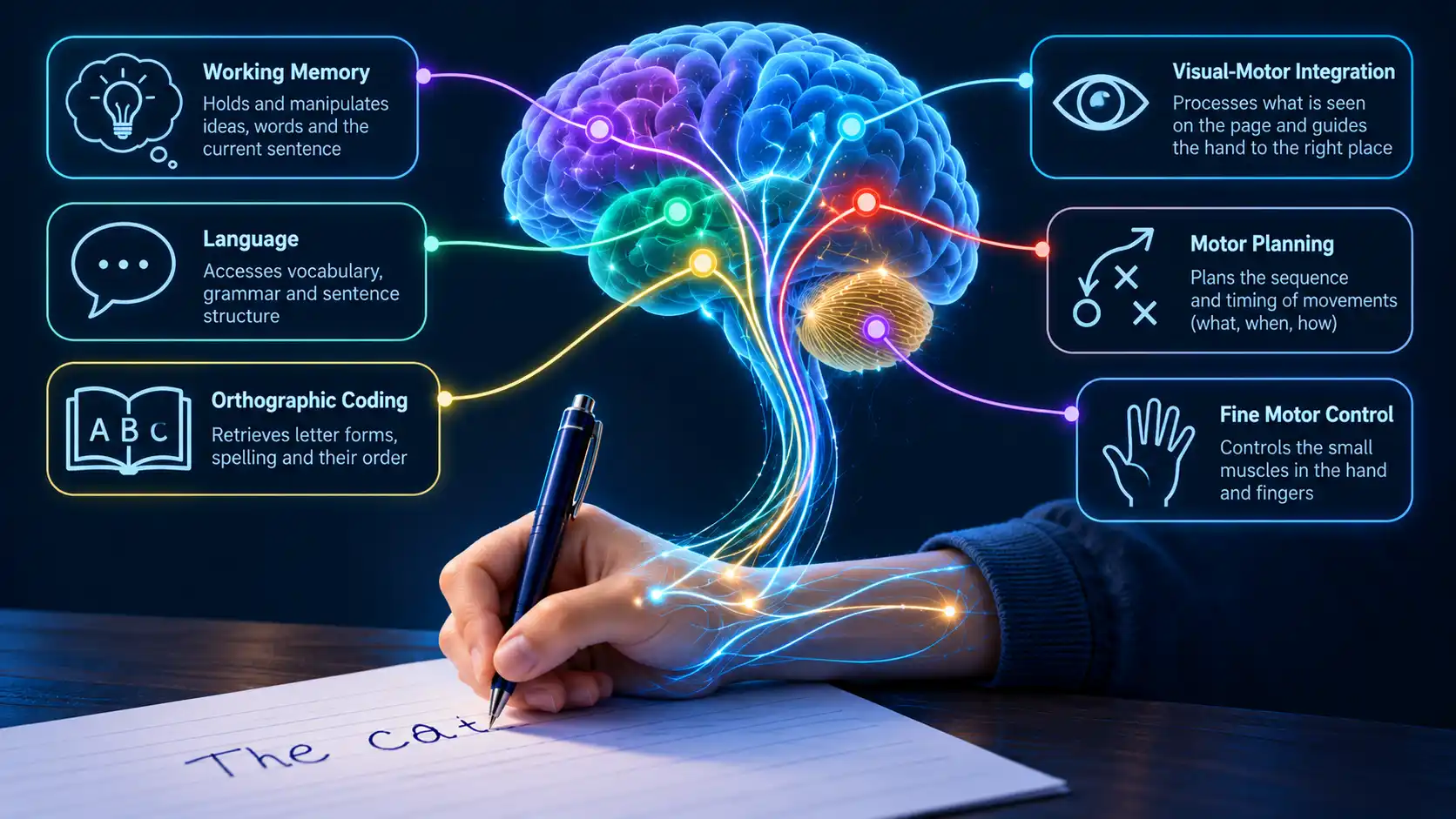
Crucially, dysgraphia is not fully understood, and several theories about its underlying mechanisms exist rather than one settled account.[1] There is no single blood test or brain scan that diagnoses it; identification rests on a careful educational and clinical picture.[1]
🧬 Family & overlap
Writing difficulties often run alongside reading difficulties, and dyslexia and dysgraphia share predictors and risk factors.[2] Because much more research exists on dyslexia than on dysgraphia, some of what is known about writing difficulty is inferred from the closely related reading literature — so claims specific to dysgraphia should be read with appropriate caution.[2]
How Dysgraphia Shows Up
Dysgraphia can present with different symptoms at different ages, and no single sign is diagnostic. The pattern below reflects features commonly described in the research and clinical literature; a formal assessment is needed to interpret them.[1][3]

| Stage | Common signs |
|---|---|
| Preschool | Awkward or tense pencil grip; difficulty learning to form letters and shapes; avoidance of drawing and colouring (these raise risk — they are not diagnostic) |
| Early school | Messy, inconsistent letters; mixing upper- and lower-case; slow, effortful, tiring writing; poor spacing and alignment; frequent spelling errors, despite good teaching |
| Later school | Writing far below what the student can express out loud; trouble organising ideas on the page; avoidance of written work; a large gap between spoken knowledge and written output |
| Adults | Ongoing difficulty with handwriting, note-taking, forms, and longer written documents — often managed with typing and other strategies, and often alongside strengths in other areas |
🌱 Difficulty that persists despite good teaching
A recurring feature is writing difficulty that persists even with instruction that works for a child's peers, and that is often greater than the person's broader development and spoken ability would predict. As with other specific learning disorders, a formal IQ–achievement discrepancy is not required to identify it.[1][7]
How Dysgraphia Is Identified
There is no single laboratory test or brain scan that can diagnose dysgraphia; identification relies on a comprehensive educational and/or clinical assessment of writing skills, developmental history, educational performance, and relevant contributing factors — carried out depending on the individual and the diagnostic or education system.[1] In DSM-5-TR, persistent writing difficulty is represented as Specific Learning Disorder, with impairment in written expression — requiring difficulties that have persisted for at least 6 months despite targeted intervention, writing skills substantially below what is expected for the person's age, onset during the school years (though sometimes clearly apparent only when demands increase), and clinically significant interference with school, work, or daily life, with alternative explanations considered.[7]
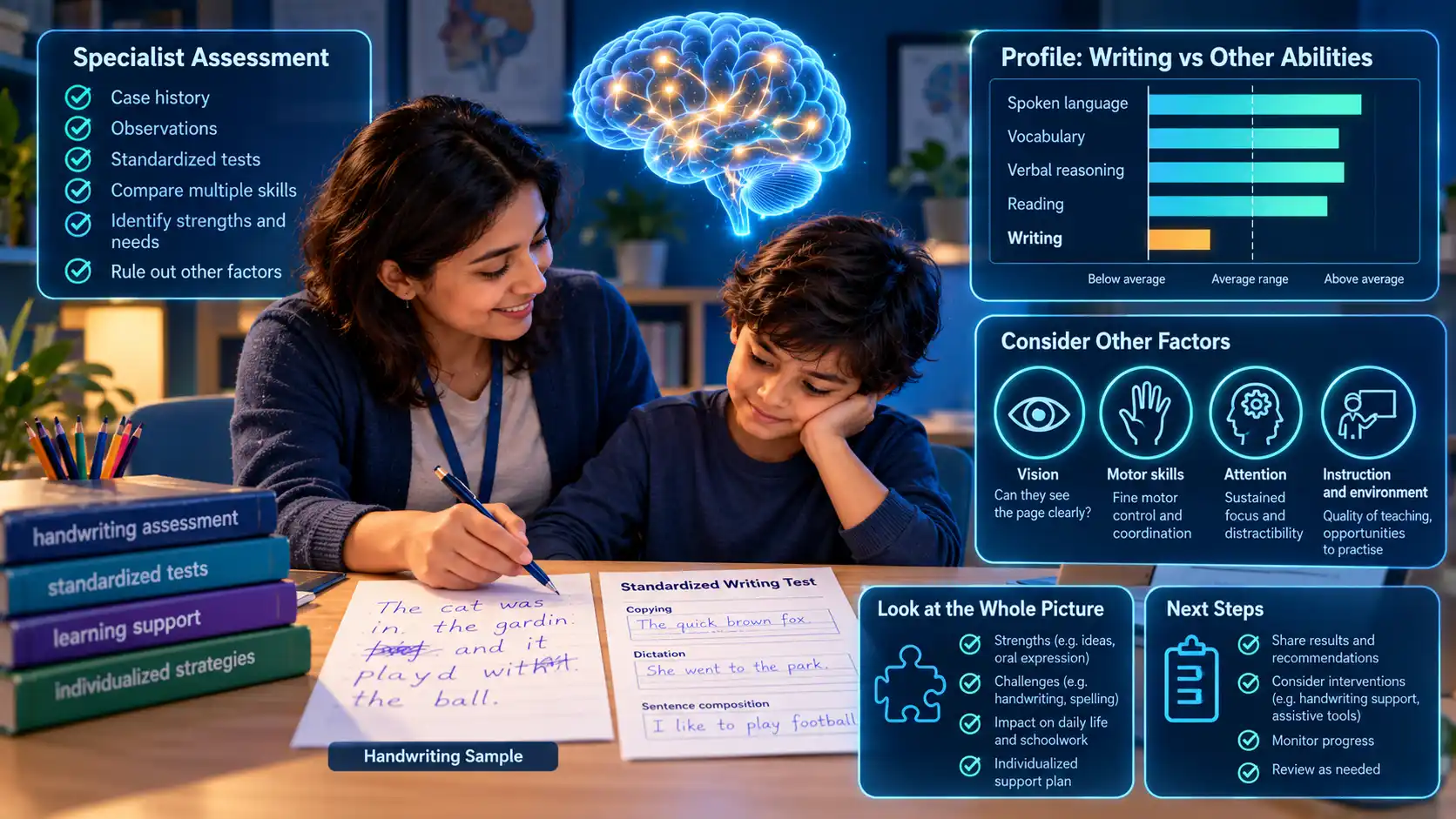
📋 What an assessment looks at
Handwriting is best evaluated with a valid, reliable, standardized tool combined with informal classroom observation and teacher consultation.[3] A fuller assessment, carried out by appropriately qualified professionals — which, depending on the country and system, may include educational or clinical psychologists, specialist teachers, or occupational therapists — looks at handwriting, spelling, and written composition set against the person's broader reasoning and spoken language.[1][3]
✅ Considering other factors
A good assessment also considers vision, fine-motor and coordination skills, attention, language, educational opportunity, and other conditions that can affect writing — to understand the full picture and ensure support fits the individual. Screening for co-occurring conditions is especially important here.[1]
What Often Travels With Dysgraphia
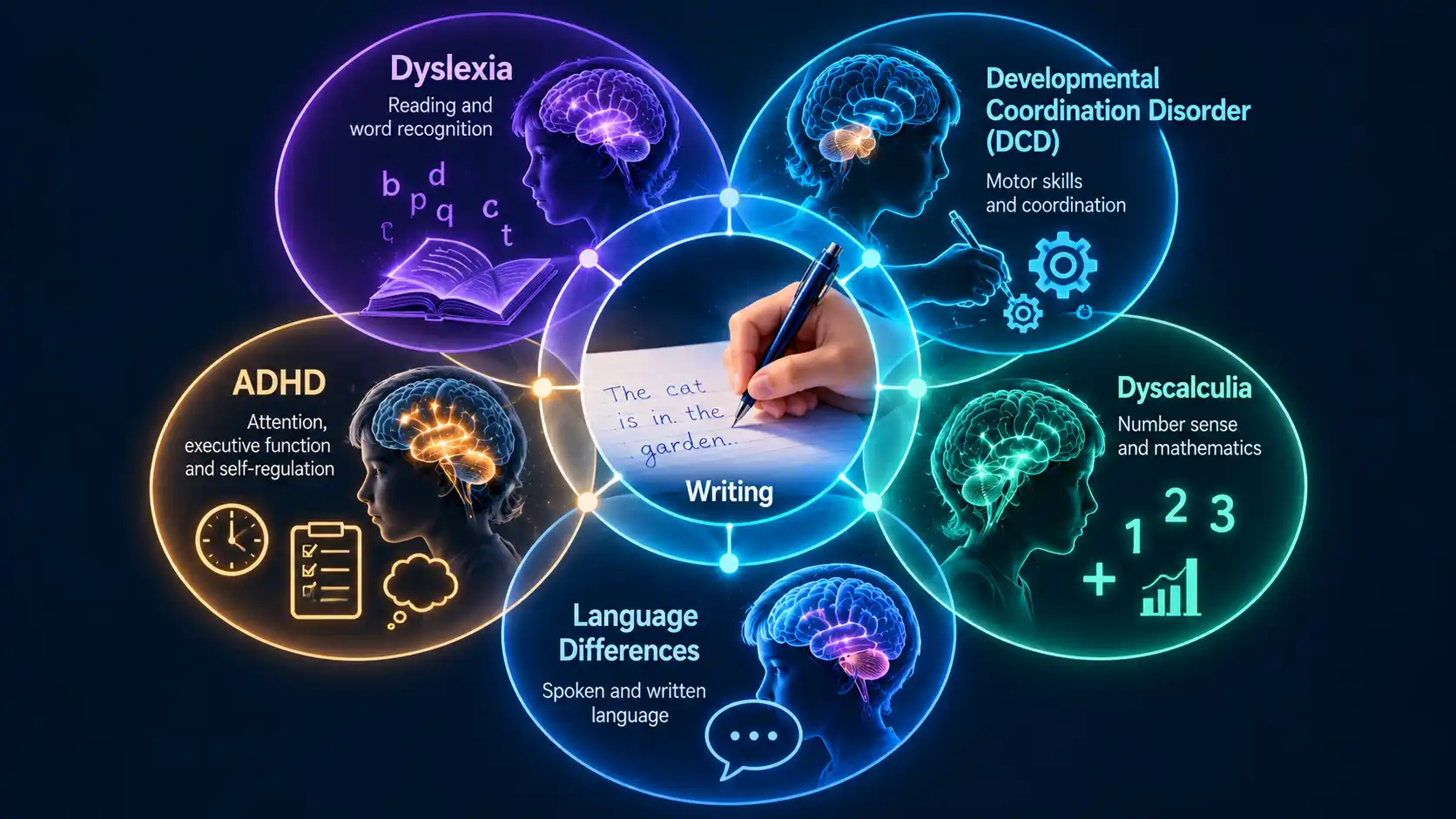
Dysgraphia has a high rate of co-occurrence with other learning and neurodevelopmental conditions, so overlap is common rather than exceptional.[1]
Dyslexia
Reading difficulty (dyslexia) and writing difficulty frequently appear together and share predictors and risk factors; spelling sits at the overlap of both.[2]
Developmental coordination disorder
DCD (a motor-coordination condition) very often affects handwriting: a 2022 systematic review and meta-analysis estimated a pooled prevalence of 84% of handwriting difficulties among children with DCD, with poorer legibility and speed.[6]
ADHD & others
Writing difficulties can also co-occur with ADHD, dyscalculia, language difficulties, and other neurodevelopmental or learning conditions, so assessment should consider the broader developmental profile.[1]
Emotional wellbeing
Writing is central to school, so persistent difficulty — and being misjudged as careless or "not trying" — can take a real toll on self-esteem and confidence, and failing to attain handwriting competency can have far-reaching effects on both academic success and self-esteem.[3] Timely identification and appropriate support may help reduce avoidable academic frustration and negative experiences around writing. If low mood becomes overwhelming, please reach out — see Support & Resources below.[1]
What Genuinely Helps
The encouraging news is that writing skills respond to teaching. Evidence supports explicit handwriting instruction and writing interventions for children experiencing handwriting and written-composition difficulties, and handwriting difficulties generally do not resolve without intervention.[3] A note on the evidence: much of this research studies handwriting and writing difficulties generally rather than people formally diagnosed with "dysgraphia", so it is applied here as a reasonable guide rather than as dysgraphia-specific proof.[3][1]

✍️ Explicit handwriting instruction
Direct, structured handwriting teaching and therapeutic practice are well supported: a systematic review found strong evidence for therapeutic practice for handwriting intervention within the scope of occupational therapy, with additional (lower-strength) support for various handwriting programmes.[5][3]
🧩 Teaching composition (SRSD)
For the ideas-on-the-page side of writing, strategy instruction has strong support. In a meta-analysis of writing instruction for primary-grade students, Self-Regulated Strategy Development (SRSD) — teaching explicit planning and self-monitoring strategies — produced large, consistent gains, with the biggest benefits for weaker writers. (The study examined primary-grade writing instruction generally rather than a diagnosed-dysgraphia group, but SRSD is particularly relevant when difficulties involve planning and organising written ideas.)[4]
🛠️ Accommodations & technology
Alongside direct teaching, accommodations remove barriers while skills develop. Possible accommodations include typing and word processors, speech-to-text, extra time, reduced copying demands, note-taking support, and allowing answers to be given orally where appropriate. Separately, individualised handwriting supports — such as pencil grips, adapted writing tools, positioning changes, and paper or line adaptations — may help some writers; note that the evidence for specific aids is more limited than for direct handwriting instruction. These supports do not "lower the bar" — they let people show what they know, and with the right support people with dysgraphia can and do thrive in education, work, and everyday life.[1]
🤝 Support & Resources
Trusted, non-commercial organisations with guidance for families, educators, and adults — plus mental-health support if the strain ever feels too much.[8][9]
If you or someone you love is struggling emotionally or in crisis, please reach out: 🇺🇸 988 (Suicide & Crisis Lifeline) · 🇬🇧 Samaritans 116 123 · or your local emergency number (911 / 999 / 112). You are not alone.
Cited Sources
Key factual claims in this article are referenced to peer-reviewed publications or authoritative organisations. Bibliographic details were verified against the primary sources via PubMed; DOI or publisher links are provided where available. Organisation links (refs [8]–[9]) are practical guidance resources rather than primary research.
- Chung, P. J., Patel, D. R., & Nizami, I. (2020). Disorder of written expression and dysgraphia: definition, diagnosis, and management. Translational Pediatrics, 9(Suppl 1), S46–S54. DOI: 10.21037/tp.2019.11.01 · Free PMC: PMC7082241 · PubMed: PMID 32206583
- Döhla, D., & Heim, S. (2016). Developmental dyslexia and dysgraphia: what can we learn from the one about the other? Frontiers in Psychology, 6, 2045. DOI: 10.3389/fpsyg.2015.02045 · Free PMC: PMC4726782 · PubMed: PMID 26858664
- Feder, K. P., & Majnemer, A. (2007). Handwriting development, competency, and intervention. Developmental Medicine & Child Neurology, 49(4), 312–317. DOI: 10.1111/j.1469-8749.2007.00312.x · PubMed: PMID 17376144
- Kim, Y.-S. G., Yang, D., Reyes, M., & Connor, C. (2021). Writing instruction improves students' writing skills differentially depending on focal instruction and children: a meta-analysis for primary grade students. Educational Research Review, 34, 100408. DOI: 10.1016/j.edurev.2021.100408 · Free PMC: PMC9390887 · PubMed: PMID 35991709
- Grajo, L. C., Candler, C., & Sarafian, A. (2020). Interventions within the scope of occupational therapy to improve children's academic participation: a systematic review. American Journal of Occupational Therapy, 74(2), 7402180030. DOI: 10.5014/ajot.2020.039016 · PubMed: PMID 32204774
- Dionne, E., Bolduc, M.-È., Majnemer, A., Beauchamp, M. H., & Brossard-Racine, M. (2022). Academic challenges in developmental coordination disorder: a systematic review and meta-analysis. Physical & Occupational Therapy in Pediatrics, 43(1), 34–57. DOI: 10.1080/01942638.2022.2073801 · PubMed: PMID 35611495
- American Psychiatric Association. (2022). Diagnostic and Statistical Manual of Mental Disorders, Fifth Edition, Text Revision (DSM-5-TR) — Specific Learning Disorder (with impairment in written expression). Washington, DC: APA. DOI: 10.1176/appi.books.9780890425787
- Understood.org. Dysgraphia — resources on writing difficulties for families and educators. Available: understood.org
- Learning Disabilities Association of America (LDA). Dysgraphia — information and resources. Available: ldaamerica.org
🤖 AI Assistance Disclosure: This article was researched and structured with the assistance of Artificial Intelligence (AI) under human editorial oversight. Key factual claims are referenced to peer-reviewed sources, and bibliographic details were verified against the primary literature via PubMed. AI-generated content may contain errors or omissions — always verify information with a qualified professional. Not a substitute for professional advice.
🚫 Non-Professional Authorship: The author(s) and editors at Ocxly Neuro Labs are not licensed medical, psychological, or educational-assessment professionals. This page is an educational synthesis of publicly available literature.